

When I first started paying closer attention to food, I wanted simple answers. I looked at calories, watched my weight, and assumed that if the number on the scale moved in the right direction, that told me most of what I needed to know.
But a new controlled trial is a good reminder that two people can lose about the same percentage of body weight and still have very different changes happening inside the body.
In the study, adults assigned to a ketogenic diet lost about 10% of their starting weight, just like people eating Mediterranean and very-low-fat plant-forward diets. The striking difference was in the liver. Liver fat fell 67% with keto, compared with 45% in each of the other two groups.
The scale looked almost identical

Researchers at Washington University School of Medicine randomized 55 adults with obesity, prediabetes, and excess liver fat to one of three diets. Forty-two people completed the randomized clinical trial published in Cell Metabolism, with 14 finishing in each group. Their average age was about 43.
The weight loss was matched very closely, not literally identical. The keto group lost 10.4% of starting weight, the Mediterranean group 10.2%, and the very-low-fat plant-forward group 10.1%. In pounds, average body weight went from roughly 252 to 226 pounds on keto, 247 to 222 pounds on Mediterranean, and 252 to 226 pounds on the plant-forward plan.
That makes the liver result much more interesting. The scale was giving almost the same answer while the liver was telling the researchers something else.
The liver told a very different story
The researchers measured intrahepatic triglyceride, which is fat stored inside the liver. The keto group began with an average liver-fat level of 19.4% and finished at 6.2%. Both higher-carbohydrate groups improved too, but by less.
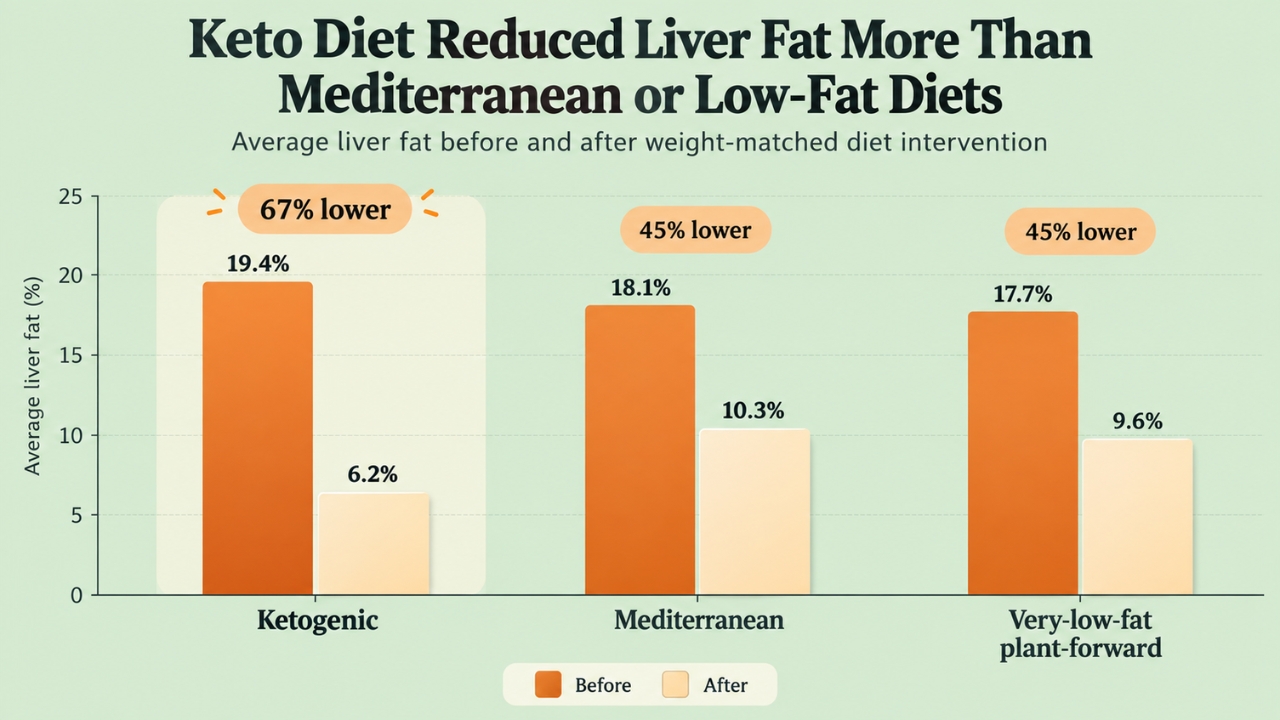
So the headline isn’t that keto caused more weight loss. It didn’t. At roughly the same 10% body-weight loss, liver fat changed more. Liver insulin sensitivity also improved two to three times more in the keto group than in either of the other groups.
I used to want one number to settle everything
When I first started paying closer attention to food, I was always looking for one simple way to tell if I was doing things right. Most of the time, that meant the scale.
If I lost weight, I took that as proof that whatever I was eating was working. I did the same thing with calories. If they fit the number I had in mind for the day, I didn’t spend much time thinking about what else might be changing inside my body.
I ran into the same problem when I wrote about the old Twinkie diet experiment. A man lost 27 pounds while eating plenty of snack foods because he kept his calories low, and several blood markers improved too. Weight loss itself can change a surprising number of measurements.
The new keto trial adds another layer to that lesson. Equal weight loss doesn’t guarantee equal changes in every organ or every metabolic marker.
The keto diet here was extremely low in carbs
The keto plan in this trial was genuinely ketogenic, not the loose version of low-carb eating where someone skips bread at lunch and calls it keto. Per 2,000 calories, the study diet supplied about 20 grams of carbohydrate, 112 grams of protein, and 164 grams of fat. Carbohydrate provided only 4% of total calories.
- Mediterranean: 50% of calories from carbohydrate, 35% from fat, and 15% from protein.
- Very-low-fat plant-forward: 70% from carbohydrate, 15% from fat, and 15% from protein.
- Ketogenic: 4% from carbohydrate, 73% from fat, and 23% from protein.
Participants weren’t handed a diet sheet and sent home. Researchers provided all meals and snacks, and logged adherence was above 95%. Few of us eat under that kind of controlled supervision in normal life.
Blood sugar changed more on keto too
View this post on Instagram
Liver fat wasn’t the only result that separated the keto group:
- Over 24 hours, glucose exposure fell 20% from baseline with keto, compared with 8% on both higher-carbohydrate diets.
- Insulin exposure dropped 74% with keto, 44% with Mediterranean eating, and 27% with the very-low-fat plan.
- Prediabetes remission differed too. Half of the keto group no longer met the study’s prediabetes criteria after weight loss, compared with 29% in the Mediterranean group and 7% in the very-low-fat group.
- At the same time, skeletal-muscle insulin sensitivity improved by about 50% in all three groups.
I think that result deserves just as much attention. Weight loss itself was clearly doing a lot of metabolic work, even in measurements where the diets didn’t separate from one another.
A 67% reduction doesn’t mean keto cured fatty liver
The trial measured liver fat and metabolic markers over about five months. It didn’t prove that every participant’s liver disease disappeared, and it can’t tell us what happened years later.
Metabolic dysfunction-associated steatotic liver disease, or MASLD, is often silent. People may have excess liver fat without obvious symptoms, so fatigue, bloating, or stomach trouble alone can’t tell you that you have it.
The National Institute of Diabetes and Digestive and Kidney Diseases says gradual weight loss can reduce liver fat. Losing at least 3% to 5% of body weight may reduce liver fat, while losses of around 7% to 10% may also help reduce liver inflammation and fibrosis.
The study was tightly controlled and still quite small
One reason I trust this comparison more than I trust a lot of diet headlines is the study setup.
Researchers supplied the food, met with participants weekly, and compared the groups after they had reached almost the same percentage of weight loss. That removes some of the usual uncertainty about people following very different diets with very different levels of adherence.
There are still real limits. Only 42 people completed the trial. Each final diet group contained 14 people, and the intervention lasted roughly five months.
Everyone had obesity, prediabetes, and fatty liver at the start, so the results don’t tell us what keto would do for a metabolically healthy person trying to lose 10 pounds.
The researchers also couldn’t determine if a less severe low-carb diet without ketosis would produce the same liver effects.
Keto didn’t seem to worsen cholesterol in this trial
The keto diet supplied 23% of its calories from saturated fat, yet the researchers found no significant differences among the groups in LDL cholesterol, apolipoprotein B, or 24-hour triglyceride levels after weight loss. No serious adverse events occurred during the trial.
Why did a keto diet with > 5X the saturated fat and 50X the cholesterol of a plant-based diet lower LDL and ApoB? https://t.co/AkUzxSU1To
— Nick Norwitz MD PhD (@nicknorwitz) September 14, 2026
That is useful short-term information. It isn’t a lifetime safety verdict. Experts reviewing the study pointed to the small sample and short follow-up, and cautioned against treating the findings as proof that keto is healthier overall than a Mediterranean pattern.
I wouldn’t use this paper to declare Mediterranean eating disproved. For this specific group, during active weight loss, severe carbohydrate restriction produced larger changes in liver fat and several measures of glucose metabolism.
The result changed how I think about a successful diet
I have written before about why bigger bodies generally use more energy, and it is easy to spend so much time thinking about calorie intake and calorie burn that body weight becomes the main scoreboard. I understand the appeal. The scale gives you a number at home in a few seconds.
Your liver doesn’t give you that kind of feedback. Neither does insulin sensitivity. Two people can lose the same 25 pounds and still end up with different changes in blood sugar, liver fat, hunger, cholesterol, muscle, or other health markers.
I saw another example of that in a trial where creatine users gained lean tissue while body fat fell during a calorie-restricted exercise program.
That doesn’t make the scale useless. It means weight is one result. A diet can affect body weight and metabolism at the same time, and the two stories won’t always be identical.
What I would do with this information

If I had fatty liver, I would want to know how much fat I actually had, what my blood sugar and lipids looked like, what medicines I was taking, and which eating pattern I could realistically maintain.
I would also remember that keto wasn’t the only diet that helped. Every group lost about 10% of body weight, every group reduced liver fat, and every group improved muscle insulin sensitivity. Even before reading this trial, that is an important part of the story.
Keto may turn out to be especially useful for some people with obesity, prediabetes, and MASLD. The study gives clinicians a reason to investigate that possibility further.
It doesn’t give everyone else a reason to start cutting carbohydrates to 20 grams tomorrow morning.