
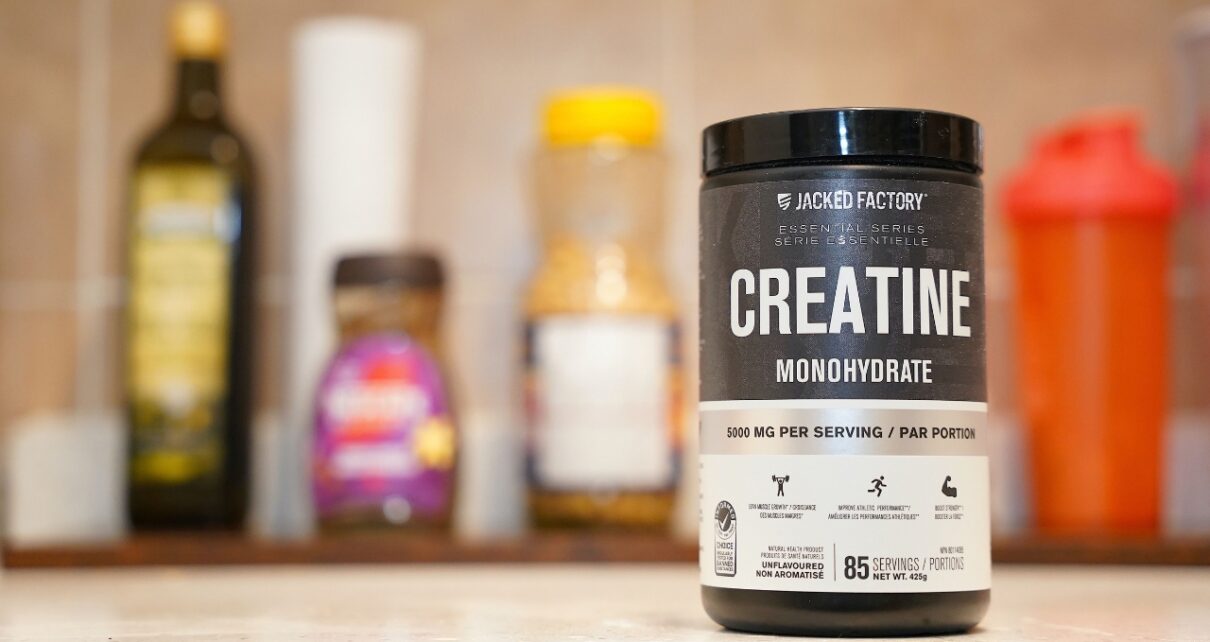
Middle-aged adults taking creatine during a 12-week diet and exercise program gained more measured lean tissue than participants following the same program with a placebo. Their body-fat percentage also fell further.
The result supports studying creatine during weight loss, but the measurement needs careful wording. The researchers used DXA scans to assess body composition. An increase in DXA lean tissue is not proof that the same amount of new skeletal muscle was built, especially when the supplement can change water retention.
What the Trial Compared
The trial published in August 2026 enrolled 73 sedentary adults. Sixty-four participants aged 45 to 65 completed the intervention and were included in the analysis.
Participants chose whether to join the exercise-and-diet program or the non-exercise track. Within each track, researchers randomly assigned creatine monohydrate or a maltodextrin placebo. Supplement assignment was double-blind.
The exercise program included supervised resistance and aerobic training three days a week. Its weight-loss component aimed for a daily calorie deficit of approximately 300 to 500 calories.
Choosing the exercise track was not randomized. Comparisons between creatine and placebo within each track therefore have a stronger basis than comparisons treating exercise participation itself as randomly assigned.
Lean Tissue Increased While Body-Fat Percentage Fell
After 12 weeks, the exercise-and-creatine group had gained an average of 1.27 kilograms of lean tissue, about 2.8 pounds. The exercise-and-placebo group gained 0.14 kilograms, about 0.3 pounds, a change the researchers described as essentially unchanged.
| Outcome After 12 Weeks | Exercise and Diet With Creatine | Exercise and Diet With Placebo |
|---|---|---|
| Average change in lean tissue | Increase of 1.27 kilograms, about 2.8 pounds | Increase of 0.14 kilograms, about 0.3 pounds |
| Average change in body-fat percentage | Decrease of 3.24 percentage points | Decrease of 1.87 percentage points |
Both exercise groups lost fat. The greater reduction in body-fat percentage with creatine should not be described automatically as an equally greater loss of fat mass.
Body-fat percentage depends on both fat mass and total body mass. Adding lean tissue can lower the percentage even without additional fat loss.
For a hypothetical example, a 100-kilogram person with 30 kilograms of fat has 30% body fat. If fat mass stays at 30 kilograms while other tissue increases total weight to 102 kilograms, body fat becomes about 29.4%. The percentage falls even though no fat has been lost. Those figures illustrate the calculation, not the trial results.
View this post on Instagram
DXA Cannot Separate New Muscle From Every Other Lean-Tissue Change
DXA lean-tissue measurements include water. They do not identify how much of a change consists of newly formed muscle protein.
In a controlled study involving 18 trained male cyclists, researchers manipulated muscle creatine and glycogen stores. Changes in water and stored metabolites altered DXA lean-mass estimates over periods when little change in muscle protein was expected.
The finding does not mean every increase during creatine use is water. It means the scan alone cannot divide the increase into water, new muscle and other lean components.
Strength improvements provide a separate measure of performance. They still cannot establish how many pounds of muscle were built. Our article on building muscle in a calorie deficit explains why strength, lean mass and skeletal muscle should be interpreted separately.
Creatine Does Not Replace Protein

The paper reports an average protein intake of approximately 74 grams a day and 0.94 grams per kilogram of body weight. Protein intake was not the randomized treatment, so the trial cannot establish that this amount was optimal or that more protein would have produced no additional benefit.
For comparison, the International Society of Sports Nutrition position stand on protein gives a general range of 1.4 to 2.0 grams per kilogram per day for most healthy exercising adults. It also discusses higher needs in some resistance-trained people during calorie restriction.
A creatine result does not remove the need to assess the rest of the diet. The supplement and dietary protein have different roles, and the study did not compare creatine against a higher-protein eating plan.
The Trial Used More Than a Typical Maintenance Dose
Participants received 10 grams of creatine monohydrate daily, divided into two 5-gram servings. The trial did not compare that dose with a lower dose.
The NIH Office of Dietary Supplements overview describes a common maintenance amount of 3 to 5 grams daily after a loading phase. Its summary also identifies creatine as useful for some forms of repeated, high-intensity activity and notes that water retention can increase body weight.
| Amount Described | Daily Creatine | What the Comparison Means |
|---|---|---|
| 2026 trial protocol | 10 grams, divided into two 5-gram servings | The amount tested in this particular study |
| Common maintenance amount described by NIH | 3 to 5 grams | A reference protocol, not an individual prescription |
The trial does not show that 10 grams is necessary for the body-composition result, or that taking twice as much produces twice the benefit. Its dosing schedule should not be copied as a weight-loss plan.
Kidney Blood Tests Need Context
Creatine and creatinine are different substances. Creatinine is a breakdown product used in blood tests to estimate kidney filtration, and supplementation can influence its concentration.
A 2025 systematic review and meta-analysis found a small increase in serum creatinine with creatine supplementation but no significant difference in glomerular filtration rate. The distinction helps explain why a creatinine change alone does not establish kidney damage.
It also does not justify dismissing an abnormal test. A clinician needs the supplement history, dose, other medicines and relevant health information to interpret the result. People with kidney disease or ongoing kidney investigations need individual advice rather than reassurance based on a general supplement article.
The Exercise Program Still Matters
The non-exercise creatine group also gained measured lean tissue and improved some strength outcomes. That observation does not establish that a supplement provides the same benefits as training. Exercise participation was self-selected, and a lean-tissue scan cannot measure every benefit of an exercise program.
For the participants in the weight-loss program, creatine was one addition to supervised training and dietary change. The prescribed deficit belongs to that research setting. Our explanation of how much of a calorie deficit to use covers why a proposed reduction must be considered alongside remaining intake and individual needs.
@trainbloom Creatine for fat loss? Actually, yeah… Creatine might actually be one of the most effective supplements to take for fat loss Not because it burns fat directly… But because it just makes everything that does, work better While most “fat burners” are busy doing… nothing Creatine actually helps with the things that matter #creatine #supplements #supplement ♬ original sound – Tony
The Findings Have Limits Beyond the Dose
The trial was short, involved sedentary adults in a particular age range, and analyzed participants who completed the intervention. Its findings cannot establish the same response in younger athletes, people with different medical conditions, or someone using creatine for a year.
The funding and disclosures also deserve a complete account. The WoodNext Foundation funded the study through a gift to the Texas A&M Foundation. Alzchem supplied the supplements and funded homocysteine testing. Senior author Richard Kreider disclosed that he chairs the AlzChem scientific advisory board. The paper states that sponsors were not involved in data collection, analysis or interpretation.
The practical question is what changed alongside body weight. A scale reading cannot separate fat, water and other tissue. Even a body-composition scan needs interpretation when creatine can affect the water included in its lean-tissue estimate.
Medical disclaimer. This article provides general information about nutrition, exercise and supplement research. It is not a substitute for individual advice from a qualified healthcare professional and does not provide a personal supplement, diet or treatment plan.